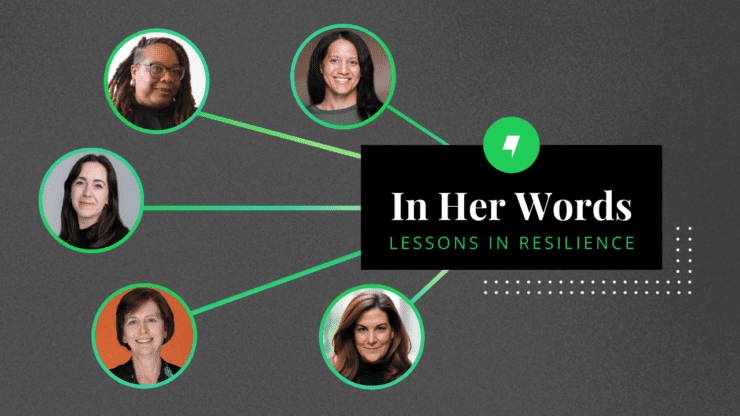
We are truly in good company at Maven. Every day we work with women we admire, and in celebration of Women’s History Month, we asked five women in leadership to share their stories on resiliency:
- Meghan Pierce, President & CEO of The Forum of Executive Women
- Natasha Johnson, CEO of Girls Inc. of Greater Philadelphia and Southern New Jersey
- Melanie McCottry, Chief of Staff & Senior Vice President, Corporate Affairs at Philadelphia Gas Works
- Jake Marini, Chief Advancement Officer at Philadelphia Foundation
- Kris Steen, President, Executive Search at Stevenson Search Partners
It’s an honor to spotlight their insights and their work as we both reflect on women’s critical contributions to our society and pursue a more equitable, inclusive future.
Last year, we reflected on the lessons we’ve learned in nearly 20 years of business as a women-owned agency, shaping us and our journey. This year, we’re excited to pass the mic.
Meghan Pierce
President & CEO, The Forum of Executive Women
Across every sector in Philadelphia, women are redefining what leadership looks like. At The Forum of Executive Women, I see it through our 600+ members who are driving policy, business, and community impact across our region.
The resilience story I keep coming back to is our own origin. In 1977, a small group of women gathered in Philadelphia because there was almost no one who looked like them at the top. No roadmap, no guarantee it would matter. They built The Forum anyway. Nearly 50 years later, that act of belief has grown into the region’s premier women’s leadership organization, with real influence on pay equity, workplace policy, and the next generation of leaders.
That is the throughline I see in women’s leadership: the willingness to build something for people who come after you, to prop the door open for who will come in next.
Natasha Johnson
CEO, Girls Inc. of Greater Philadelphia and Southern New Jersey
Women in the nonprofit sector embody resilience every day, leading through constant change while remaining deeply grounded in mission, equity, and community impact. In an environment shaped by shifting funding priorities, evolving community needs, and increasing expectations for measurable results, women leaders do more than adapt—we innovate. At Girls Inc., we anticipate change, strengthen partnerships, and design new pathways to sustain and expand the programs our communities rely on. Throughout my career, resilience has meant maintaining clarity of purpose in the face of uncertainty: holding fast to the vision of expanding opportunity for girls and young women, while knowing when to pivot, when to build new coalitions, and how to move transformative work forward even when resources or systems demand new approaches.
Resilience in this sector also means scaling impact while stewarding limited resources with intention and strategic discipline. Women leaders are often asked to do more with less—aligning funding streams, deepening collaboration, and building innovative programs that reach more people without compromising quality. In my work, that has meant expanding programs, cultivating cross-sector partnerships, and strengthening organizational systems that allow us to grow while staying responsive to the communities we serve. True resilience is not just about weathering challenges; it’s about evolving, innovating, and ensuring that mission-driven work continues to create meaningful, lasting change.
Melanie McCottry
Chief of Staff & Senior Vice President, Corporate Affairs, Philadelphia Gas Works
As a woman working in the energy industry, resilience is essential. Resilience becomes essential not only for career progression but for navigating a normal workday in this industry.
We serve over a half million people every day at Philadelphia Gas Works, so no two days are ever the same. There are frequently new problems to help solve, and the more flexible you can be, the greater impact you can have on performing good work and helping people. Women who thrive in this space are shaping the future of global energy systems for decades to come. Our resilience is not just personal strength—it is strategic, transformative, and essential to the industry’s evolution.
A lesson I’d pass on is that compassionate leadership does not mean weakness or indecision. Rather, it integrates strength with emotional intelligence. I aim to be thoughtful and consistent in my leadership so that I can make things better than before – which is one of PGW’s core values. Being compassionate is not a strategy; it is a value that I believe serves people and teams better. Collaboration requires trust. If I bring my best self, I hope others will too.
The energy industry needs diverse leadership more than ever. Diversity delivers better outcomes. I am often in spaces where I am the only woman, and often the only person of color, and those instances fuel my desire to represent for those not in the room. When multiple viewpoints are considered, decisions are more balanced and risks are evaluated more thoroughly. Innovation thrives on difference and the inclusion of other perspectives. I always encourage leaders to share their unique knowledge, invite others to the table, and pursue leadership roles in environments that may not yet fully support them.
Jake Marini
Chief Advancement Officer, Philadelphia Foundation
The data points hit my inbox practically every day. Statistics like:
- By 2030, women will control two-thirds of US private wealth.
- With the great wealth transfer anticipated over the next two decades, it is estimated that women—either as heirs, beneficiaries, or surviving spouses—will manage $100 trillion of those assets.
- Women control or influence 85% of charitable giving decisions in the US.
None of this is surprising. I see similar patterns borne out at Philadelphia Foundation. Women are driving philanthropy through their donor-advised funds, giving circles, planned gifts, and impact investing. Their giving tends to be values-focused and community-centered.
And these donors are not just contributing more. They are also organizing and building networks of influence that amplify their impact. The result is a philanthropic landscape that is more inclusive and attuned to the needs of communities.
So, while March is the month to celebrate women’s history, from a philanthropy perspective, it’s the future that’s female.
Kris Steen
President, Executive Search, Stevenson Search Partners
Life sciences is inherently mission-driven, sitting at the intersection of science and human impact. Women leaders are proportionately more motivated by purpose and long-term societal contribution, an alignment that naturally draws many women to biotech, medtech, and healthcare, where the work directly affects patients’ lives. Women leaders often emphasize stakeholder models vs. purely shareholder models. In life sciences, stakeholders include patients, regulators, physicians, and caregivers (not just investors). That broader lens can lead to more inclusive clinical trials, greater attention to rare disease and women’s health, and higher trust with regulators and partners.
From first-time CEOs to serial executives, Stevenson Search Partners has worked with dozens of female CEOs that share the same stories about financial barriers. On average, female CEOs have to meet with twice as many investors to secure funding. Some of them have been told, “You need to hire a male Chairman to bring more credibility to the team.” The resilience we see isn’t just persistence, it’s strategic adaptability…over-preparation, stronger governance, diverse advisory boards, and capital discipline. These women aren’t just navigating bias; they’re building companies that outperform because of it.
One of the most powerful outcomes in female leadership in life sciences is the community that women are organically building to support one another. Organizations like The Biotech CEO Sisterhood and Medtech Women began with a few women discussing how isolating it can be at the top, often being the only women at the Board table, and not feeling like they had a support system, especially not one designed for female leaders. So they did what most women do – they built a support system. These groups now have over hundreds of members, have been nationally recognized, and offer guidance, market data, and a space to grow and learn.
At Stevenson, we pride ourselves on a 52% diverse hiring rate, a metric we are proud of and track intentionally across our teams. We know that diversity at all levels of an organization improves outcomes through varying perspectives and ideas. Since its inception, Stevenson has supported Women in Bio’s Boardroom ready program through both financial sponsorship and serving as a program advisor, with the goal of getting more female representation in boardrooms. All of our work is important to help drive change not just in the life sciences ecosystem but across leadership in the industry.
Beyond the Talk
We’re incredibly grateful to the women who shared their stories and continue to inspire us. Thank you to Meghan, who is at the helm of an organization supporting over 600 women who hold the senior-most positions across industries in our region; Natasha, who leads the longest-running nonprofit girls’ leadership program, one she helped rebuild and scale; Melanie, who oversees the service of over a half million Philadelphians daily and the municipally-owned organization’s team; Jake, who strategically cultivates funding to support a 100-year history of building positive outcomes in Philadelphia; and Kris, who steers the placement of executives across the highest-caliber organizations in life sciences, helping advance positive health outcomes.
This month and beyond, we continue to celebrate the accomplishments and contributions women have made to our society, culture, and history. There is work yet to be done, but it’s an honor to work towards a better future together.
Posted In Thought Leadership